ROAST duck
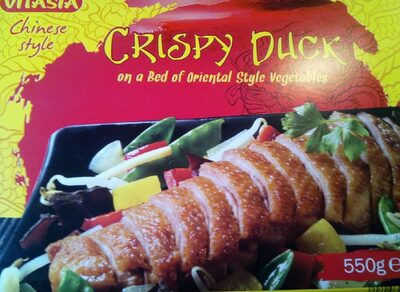
Packaged product Volailles Vitasia
ROAST duck contains 140 kcal per 100 g. A serving, 550 g (550 g) provides about 770 kcal.
Roughly 58 % of its calories come from fat, with 36 % from protein and 7 % from carbohydrates (estimated with general energy factors).
That is less energy than the typical item in volailles on FoodFactly, where the median is 192 kcal per 100 g across 16 products.
The values are as declared on the product label and entered by Open Food Facts contributors.
Nutrition facts
| Nutrient | Amount per 100 g | % DV |
|---|---|---|
| Calories L | 140 kcal | |
| Total fat L | 8,8 g | 11 % |
| Saturated fat L | 2,4 g | 12 % |
| Sodium L | 412 mg | 18 % |
| Total carbohydrates L | 2,3 g | 0,8 % |
| Dietary fiber | not reported | |
| Total sugars L | 1,9 g | |
| Protein L | 12,3 g | 25 % |
% DV: percent of the FDA Daily Value for adults (reference amounts). Letters show how each value was obtained: M measured, C calculated, L label, Z assumed zero, I imputed. Vitamins and minerals not listed were not reported by the source.
Nutritional breakdown
- Protein 36 %
- Carbohydrates 7 %
- Fat 58 %
Approximate share of calories, using general energy factors (4 kcal/g protein and carbohydrate, 9 kcal/g fat, 7 kcal/g alcohol).
Nutritional insights
- Protein12,3 gin the lowest quarter of volailles (median 16 g)
- Sugars1,9 gin the top quarter of volailles (median 0,55 g)
- Fat8,8 gbelow the median for volailles (median 10,7 g)
- Saturated fat2,4 gbelow the median for volailles (median 3,3 g)
- Sodium412 mgabove the median for volailles (median 304 mg)
- Protein per 100 kcal8,8 gprotein density, useful for comparing foods with different calorie levels
Product details
- Brand
- Vitasia
- Barcode
- 20400828
- Quantity
- 550g
- Label serving
- 550 g
- Category
- Roasted duck meat
- Nutri-Score
- C as computed by Open Food Facts
Ingredients
Ingredients not reported.
Similar products
| Food | Calories | Protein | Carbs | Fat |
|---|---|---|---|---|
| Canard rôti en émincés Le Gaulois | 131 | 25 g | 1 g | 3 g |
| Canard rôti aux pruneaux Saveur d'Auge | 131 | 13 g | 5,9 g | 5,2 g |
| rôti de filet de canard x1 s/vide Le gaulois | 155 | 20 g | 0 g | 8,2 g |
| 2 Filets de Canard Rôtis Le Gaulois | 165 | 20 g | 1,7 g | 8,7 g |
| Canard roti aux pruneaux et à l'armagnac Saveur d'Auge | 111 | 11 g | 4,1 g | 4,5 g |
| Canard roti aux trois pouvres Saveur d'Auge | 109 | 11 g | 3,5 g | 5,4 g |
| Boneless Roasted Duck Medal Duck | 190 | 20 g | 4 g | 12,2 g |
| Roasted Duck Royal Duck | 195 | 26,1 g | 2 g | 9,2 g |
Per 100 g. Calories in kcal. n/a: not reported by the source.
Frequently asked questions
How many calories are in ROAST duck?
100 g of ROAST duck has 140 kcal. Serving, 550 g (550 g): about 770 kcal.
Is ROAST duck high in protein?
ROAST duck contains 12,3 g of protein per 100 g (25 % of the 50 g Daily Value), or 67,7 g in serving, 550 g (550 g). About 36 % of its calories come from protein. Compared with other volailles, that is in the lowest quarter (median 16 g).
How many carbs are in ROAST duck?
ROAST duck has 2,3 g of total carbohydrates per 100 g, including 1,9 g of sugars. Label conventions differ: in the EU and some other regions carbohydrates are declared without fiber.
How much fat is in ROAST duck?
ROAST duck contains 8,8 g of fat per 100 g, of which 2,4 g is saturated (12 % of the Daily Value).
How much sodium is in ROAST duck?
100 g contains 412 mg of sodium, 18 % of the 2,300 mg Daily Value.
Where does this nutrition data come from?
From Open Food Facts, record dated 25 mars 2026. FoodFactly last checked it on 6 novembre 2026. Each value above shows whether it was measured, calculated or taken from a label.
Source of the nutrition information
- Open Food Facts, record 20400828. License: ODbL 1.0 (Open Food Facts). Source record dated 25 mars 2026. Imported 6 novembre 2026.
Last updated: . Data quality score: 85/100 (how it is calculated).
Product data from Open Food Facts, made available under the Open Database License. Values are as declared on the label; labels can change over time, so check the package you have.
General nutrition information, not medical advice. Individual needs differ; see our disclaimer.