Tee Apfel
Packaged product Getränke Teekanne
Tee Apfel contains 2 kcal per 100 ml. A Serving, 200 ml (200 ml) provides about 4 kcal.
Roughly 41 % of its calories come from carbohydrates, with 31 % from fat and 28 % from protein (estimated with general energy factors).
That is close to the median for Getränke on FoodFactly (2 kcal per 100 g).
100 ml provides 11 % of the Daily Value for Vitamin C.
The values are as declared on the product label and entered by Open Food Facts contributors.
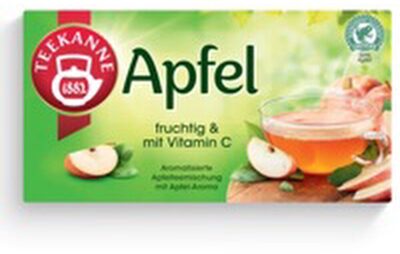
Nutrition facts
| Nutrient | Amount per 100 ml | % DV |
|---|---|---|
| Calories L | 2 kcal | |
| Total fat L | 0,1 g | 0,1 % |
| Saturated fat L | 0,1 g | 0,5 % |
| Sodium L | 4 mg | 0,2 % |
| Total carbohydrates L | 0,3 g | 0,1 % |
| Dietary fiber | not reported | |
| Total sugars L | 0,2 g | |
| Protein L | 0,2 g | 0,4 % |
| Vitamin C L | 10 mg | 11 % |
% DV: percent of the FDA Daily Value for adults (reference amounts). Letters show how each value was obtained: M measured, C calculated, L label, Z assumed zero, I imputed. Vitamins and minerals not listed were not reported by the source.
Nutritional breakdown
- Protein 28 %
- Carbohydrates 41 %
- Fat 31 %
Approximate share of calories, using general energy factors (4 kcal/g protein and carbohydrate, 9 kcal/g fat, 7 kcal/g alcohol).
Vitamins and minerals, % Daily Value per 100 ml
Nutritional insights
- Protein0,2 gin the top quarter of Getränke (median 0 g)
- Fat0,1 gin the top quarter of Getränke (median 0 g)
- Saturated fat0,1 gin the top quarter of Getränke (median 0 g)
- Sodium4 mgin the top quarter of Getränke (median 0 mg)
- Protein per 100 kcal10 gprotein density, useful for comparing foods with different calorie levels
Product details
Ingredients
Äpfel (54%), Hagebutten, Orangenschalen, Hibiskus, Säuerungsmittel: Citronensäure, Apfelaroma, Säuerungsmittel: Äpfelsäure, Zitronenschalen, Vitamin C
As listed on the package and transcribed by Open Food Facts contributors. Always check the package for allergens.
Ingredient guides: Apple
Similar products
| Food | Calories | Protein | Carbs | Fat |
|---|---|---|---|---|
| Thé cranberry orange tea Friends | 2 | 0,1 g | 0,4 g | 0,1 g |
| Holi hindou Meßmer | 2 | 0 g | 0,6 g | 0 g |
| Frio Limette-Minze Tee kalt Teekanne | 2 | 0,2 g | 0,3 g | 0,1 g |
| Meßmer Türkischer Bayram Apfel-feige Meßmer | 2 | 0 g | 0,6 g | 0 g |
| Tee Türkischer Apfel Teekanne | 2 | 0 g | 0,4 g | 0 g |
| Tee: Spanische Orange Teekanne | 2 | 0 g | 0,4 g | 0 g |
| Tee Prinzessin Lillifee Erdbeere-Himbeere Teekanne | 2 | 0,2 g | 0,3 g | 0,1 g |
| Winterzeit mit Spekulatiusgeschmack Teebeutel Teekanne | 2 | 0,2 g | 0,3 g | 0,1 g |
Per 100 g. Calories in kcal. n/a: not reported by the source.
Frequently asked questions
How many calories are in Tee Apfel?
100 ml of Tee Apfel has 2 kcal. Serving, 200 ml (200 ml): about 4 kcal.
How much protein is in Tee Apfel?
Tee Apfel contains 0,2 g of protein per 100 ml (0,4 % of the 50 g Daily Value), or 0,4 g in Serving, 200 ml (200 ml). About 28 % of its calories come from protein. Compared with other Getränke, that is among the highest quarter (median 0 g).
How many carbs are in Tee Apfel?
Tee Apfel has 0,3 g of total carbohydrates per 100 ml, including 0,2 g of sugars. Label conventions differ: in the EU and some other regions carbohydrates are declared without fiber.
How much fat is in Tee Apfel?
Tee Apfel contains 0,1 g of fat per 100 ml, of which 0,1 g is saturated (0,5 % of the Daily Value).
What vitamins and minerals does Tee Apfel contain?
Per 100 ml, the most notable amounts relative to the Daily Value are Vitamin C (11 % DV). The full list is in the vitamins and minerals table above.
How much sodium is in Tee Apfel?
100 ml contains 4 mg of sodium, 0,2 % of the 2,300 mg Daily Value.
Where does this nutrition data come from?
From Open Food Facts, record dated 25. März 2026. FoodFactly last checked it on 6. November 2026. Each value above shows whether it was measured, calculated or taken from a label.
Source of the nutrition information
- Open Food Facts, record 4009300005926. License: ODbL 1.0 (Open Food Facts). Source record dated 25. März 2026. Imported 6. November 2026.
Last updated: . Data quality score: 90/100 (how it is calculated).
Product data from Open Food Facts, made available under the Open Database License. Values are as declared on the label; labels can change over time, so check the package you have.
General nutrition information, not medical advice. Individual needs differ; see our disclaimer.