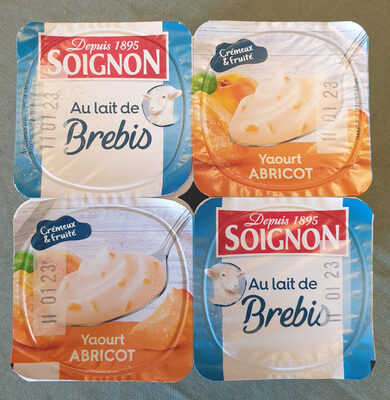
Brassé au lait de brebis
Packaged product Dairy and Eggs Soignon
Brassé au lait de brebis contains 107 kcal per 100 g. A serving, 110 g (110 g) provides about 117 kcal.
Roughly 46% of its calories come from fat, with 37% from carbohydrates and 16% from protein (estimated with general energy factors).
That is more energy than the typical item in dairy and eggs on FoodFactly, where the median is 96 kcal per 100 g across 116 products.
100 g provides 23% of the Daily Value for Vitamin B12, 20% of the Daily Value for Riboflavin (B2) and 12% of the Daily Value for iodine.
The values are as declared on the product label and entered by Open Food Facts contributors.
Nutrition facts
| Nutrient | Amount per 100 g | % DV |
|---|---|---|
| Calories L | 107 kcal | |
| Total fat L | 5.5 g | 7% |
| Saturated fat L | 3.9 g | 20% |
| Cholesterol L | 20.5 mg | 7% |
| Sodium L | 0 mg | 0% |
| Total carbohydrates L | 10 g | 4% |
| Dietary fiber L | 0.12 g | 0.4% |
| Total sugars L | 10 g | |
| Added sugars L | 7.1 g | 14% |
| Protein L | 4.3 g | 9% |
| Vitamin A L | 15.4 µg | 2% |
| Vitamin C L | 3.4 mg | 4% |
| Vitamin D L | 0.15 µg | 0.8% |
| Vitamin E L | 0.16 mg | 1% |
| Thiamin (B1) L | 0.045 mg | 4% |
| Riboflavin (B2) L | 0.26 mg | 20% |
| Niacin (B3) L | 0.32 mg | 2% |
| Pantothenic acid (B5) L | 0.33 mg | 7% |
| Vitamin B6 L | 0.049 mg | 3% |
| Folate (B9) L | 7.5 µg | 2% |
| Vitamin B12 L | 0.54 µg | 23% |
| Calcium L | 153 mg | 12% |
| Iron L | 0.37 mg | 2% |
| Magnesium L | 13.7 mg | 3% |
| Phosphorus L | 122 mg | 10% |
| Potassium L | 97.3 mg | 2% |
| Zinc L | 0.42 mg | 4% |
| Copper L | 0.013 mg | 1% |
| Manganese L | 0.019 mg | 0.8% |
| Selenium L | 3.3 µg | 6% |
| Iodine L | 18.4 µg | 12% |
% DV: percent of the FDA Daily Value for adults (reference amounts). Letters show how each value was obtained: M measured, C calculated, L label, Z assumed zero, I imputed. Vitamins and minerals not listed were not reported by the source.
Nutritional breakdown
- Protein 16%
- Carbohydrates 37%
- Fat 46%
Approximate share of calories, using general energy factors (4 kcal/g protein and carbohydrate, 9 kcal/g fat, 7 kcal/g alcohol).
Vitamins and minerals, % Daily Value per 100 g
Nutritional insights
- Protein4.3 gin the top quarter of dairy and eggs (median 3.4 g)
- Fiber0.12 gbelow the median for dairy and eggs (median 0.2 g)
- Sugars10 gin the lowest quarter of dairy and eggs (median 12.8 g)
- Fat5.5 gin the top quarter of dairy and eggs (median 3 g)
- Saturated fat3.9 gin the top quarter of dairy and eggs (median 2 g)
- Sodium0 mgin the lowest quarter of dairy and eggs (median 40 mg)
- Protein per 100 kcal4 gprotein density, useful for comparing foods with different calorie levels
- Water68.6 gwater per 100 g, which largely explains differences between raw, cooked and dried forms
Full nutrient profile
Sugars and starch (1)
| Starch L | 0.013 g |
|---|
Carotenoids (1)
| Beta-carotene L | 163 µg |
|---|
Other components (2)
| Water L | 68.6 g |
|---|---|
| Alcohol L | 0 g |
Product details
- Brand
- Soignon
- Barcode
- 3523230039604
- Quantity
- 440 g (4x110g)
- Label serving
- 110 g
- Category
- Apricot yogurts
- Packaging
- Plastic,pot,Cardboard
- Nutri-Score
- C as computed by Open Food Facts
- NOVA group
- 4 processing level (1 to 4), as classified by Open Food Facts
Ingredients
lait entier de brebis pasteurisé (origine UE), abricot (7,2%), sucre (7,1%), concentré de carotte, amidon, arôme naturel, épaississants : pectines, gomme xanthane, ferments lactiques (lait).
As listed on the package and transcribed by Open Food Facts contributors. Always check the package for allergens.
Similar products
| Food | Calories | Protein | Carbs | Fat |
|---|---|---|---|---|
| Yaourt Bulgare Abricot Brasse Aux Fruits Biochamps | 107 | 3.1 g | 18 g | 2.4 g |
| Yaourt Aux Abricots La Vie Claire | 107 | 3.1 g | 18 g | 2.4 g |
| Mclassic Quark, Aprikose M-Classic | 106 | 6.2 g | 15 g | 2.4 g |
| Yaourt brassé sur lit de confiture d'abricots - Au lait entier Casino | 106 | 2.4 g | 16 g | 3.6 g |
| Yaourt sur lit de confiture d'abricot Leader Price | 106 | 2.4 g | 16 g | 3.6 g |
| Yaourt Abricot Ferme du Marais | 108 | 3.8 g | 15.4 g | 3.4 g |
| Yaourt Prélys | 108 | 3.4 g | 17 g | 2.9 g |
| Yaourt abricot bio Marie Morin | 108 | 4.4 g | 15 g | 3.4 g |
Per 100 g. Calories in kcal. n/a: not reported by the source.
Source of the nutrition information
- Open Food Facts, record 3523230039604. License: ODbL 1.0 (Open Food Facts). Source record dated August 17, 2026. Imported November 6, 2026.
Last updated: . Data quality score: 100/100 (how it is calculated).
Product data from Open Food Facts, made available under the Open Database License. Values are as declared on the label; labels can change over time, so check the package you have.
General nutrition information, not medical advice. Individual needs differ; see our disclaimer.