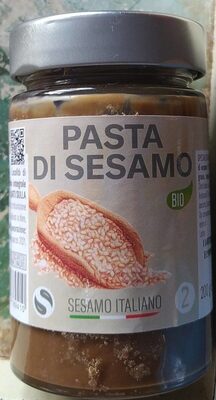
Pasta Di Sesamo
Packaged product Grains and Pasta Salvia
Pasta Di Sesamo contains 570 kcal per 100 g.
Roughly 73% of its calories come from fat, with 15% from carbohydrates and 12% from protein (estimated with general energy factors).
That is more energy than the typical item in grains and pasta on FoodFactly, where the median is 346 kcal per 100 g across 24,518 products.
The values are as declared on the product label and entered by Open Food Facts contributors.
Nutrition facts
The source reports no household measures (such as cups or pieces) for this food, so only weights are offered.
| Nutrient | Amount per 100 g | % DV |
|---|---|---|
| Calories L | 570 kcal | |
| Total fat L | 49 g | 63% |
| Saturated fat L | 6 g | 30% |
| Sodium L | 212 mg | 9% |
| Total carbohydrates L | 23 g | 8% |
| Dietary fiber | not reported | |
| Total sugars L | 0.5 g | |
| Protein L | 18 g | 36% |
% DV: percent of the FDA Daily Value for adults (reference amounts). Letters show how each value was obtained: M measured, C calculated, L label, Z assumed zero, I imputed. Vitamins and minerals not listed were not reported by the source.
Nutritional breakdown
- Protein 12%
- Carbohydrates 15%
- Fat 73%
Approximate share of calories, using general energy factors (4 kcal/g protein and carbohydrate, 9 kcal/g fat, 7 kcal/g alcohol).
Nutritional insights
- Protein18 gin the top quarter of grains and pasta (median 8 g)
- Sugars0.5 gin the lowest quarter of grains and pasta (median 2.2 g)
- Fat49 gin the top quarter of grains and pasta (median 2.9 g)
- Saturated fat6 gin the top quarter of grains and pasta (median 0.53 g)
- Sodium212 mgabove the median for grains and pasta (median 132 mg)
- Protein per 100 kcal3.2 gprotein density, useful for comparing foods with different calorie levels
Product details
- Brand
- Salvia
- Barcode
- 8056518789410
- Category
- Grains and Pasta
Ingredients
Ingredients not reported.
Similar products
| Food | Calories | Protein | Carbs | Fat |
|---|---|---|---|---|
| Pasta Untable De Semilla De Árbol De Guanacaste Igo | 570 | 20 g | 50 g | 25 g |
| Pastas de mantequilla reydulce | 570 | 6 g | 62 g | 26 g |
| Pasta de maní Fakin Bomb | 570 | 25.5 g | 14.5 g | 45.5 g |
| Pasta Duo Plus | 570 | 1.7 g | 56 g | 36.3 g |
| Chocopasta Wit JUMBO | 570 | 3.5 g | 58 g | 36 g |
| Graines de Courges Happy Bio | 570 | 36 g | 1.2 g | 45 g |
| Pasta Duo PLUS | 570 | 1.7 g | 59 g | 36.3 g |
| AH Biologisch Hazelnootpasta AH Biologisch | 570 | 4.9 g | 47.5 g | 40.3 g |
Per 100 g. Calories in kcal. n/a: not reported by the source.
Source of the nutrition information
- Open Food Facts, record 8056518789410. License: ODbL 1.0 (Open Food Facts). Source record dated March 30, 2026. Imported November 7, 2026.
Last updated: . Source description: "PASTA DI SESAMO". Data quality score: 80/100 (how it is calculated).
Product data from Open Food Facts, made available under the Open Database License. Values are as declared on the label; labels can change over time, so check the package you have.
General nutrition information, not medical advice. Individual needs differ; see our disclaimer.